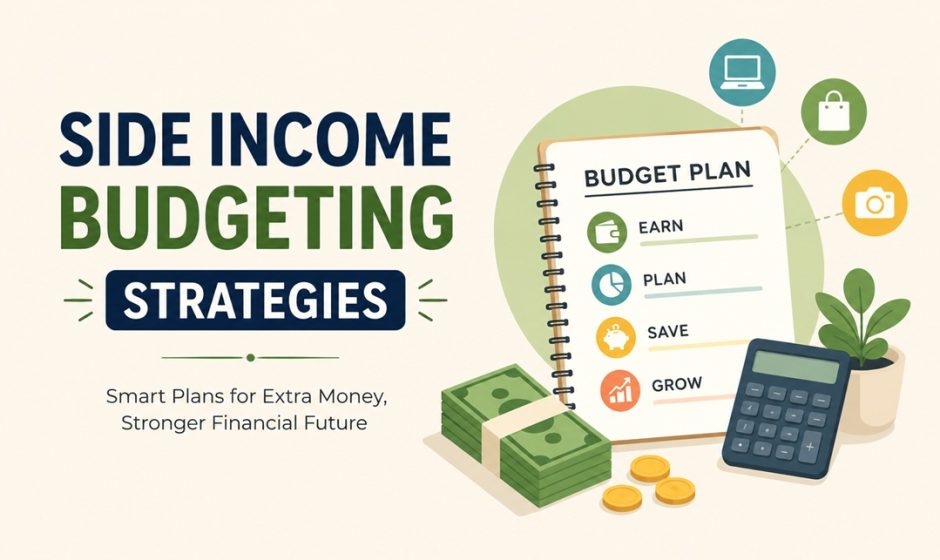

The quickest answer: keep side income separate from your main budget, and split it by percentage — a portion to taxes, a portion to savings or debt, and the rest available to spend. Treating side income like an extension of your regular paycheck is the most common mistake, and it’s usually what causes people to either overspend it or get blindsided by a tax bill.
Why Side Income Needs Its Own Rules
Money from a side hustle behaves differently than a regular paycheck. It’s irregular, it’s often untaxed at the source, and it tends to feel like “extra” money even when it’s doing real financial work — like paying down debt or funding a goal. Treating it the same way you treat your main income usually backfires in one of two ways: either it gets absorbed into everyday spending without you noticing, or it creates a surprise tax bill because nothing was set aside.
A Checklist for Setting It Up Right
Before you spend a dollar of side income, run through this:
- Open a separate account for it. Even a basic savings account works. The separation alone makes overspending much harder, because the money isn’t sitting in your everyday checking balance tempting you.
- Set aside money for taxes first. If you’re a U.S. freelancer or independent contractor, a common starting point is setting aside roughly 25–30% for federal and self-employment taxes, though the right percentage depends on your total income and state, so check with a tax professional if your side income is substantial.
- Decide your split before the money arrives, not after. A common structure: 30% taxes, 40% toward a specific goal (debt, savings, investing), 30% guilt-free spending.
- Track it separately from your main budget app or spreadsheet. Mixing it in makes it nearly impossible to see whether the side hustle is actually worth the time it takes.
The Detailed Guide: Building a System That Holds Up
Start with a percentage-based allocation rather than a fixed dollar amount, since side income is rarely consistent month to month. A percentage split scales naturally — a slow month and a strong month both get handled by the same rule, instead of needing a new plan every time.
For irregular income specifically, it helps to think in terms of a “floor” and an “overflow.” Your floor is the minimum you can reasonably expect even in a slow month — treat that as semi-reliable and let it support a small recurring goal, like an extra debt payment. Anything above the floor is overflow, and overflow should go toward goals that don’t depend on consistency: a vacation fund, an emergency fund top-up, or extra investing.
Reinvesting in the side hustle itself is worth budgeting for too, especially in the early stages. Whether that’s better equipment, advertising, or a course that improves your output, setting aside even 10% for reinvestment can compound the income over time — just don’t let “reinvesting” become an excuse to spend the whole thing without ever banking progress.
Tools That Make This Easier
A dedicated savings account with sub-buckets (many banks now offer this natively) removes a lot of the manual math. Some freelancers also use a simple spreadsheet with three columns — income received, tax set-aside, and remaining balance — updated every time a payment comes in, which takes minutes and prevents the year-end scramble.
If your side income has grown past casual hobby money into something closer to a second job, it’s worth treating tax setting-aside as non-negotiable, automated the moment money arrives, rather than something you’ll “get to” later. Quarterly estimated tax payments exist for a reason, and the penalty for skipping them is usually smaller than people fear but real enough to be annoying.
Side income is one of the few financial tools that can genuinely speed up a goal — paying off debt faster, building a cushion, or funding something your main paycheck can’t stretch to. The strategies that work long-term aren’t complicated. They just require treating the money with a bit more structure than “it’s extra, I’ll figure it out later.”