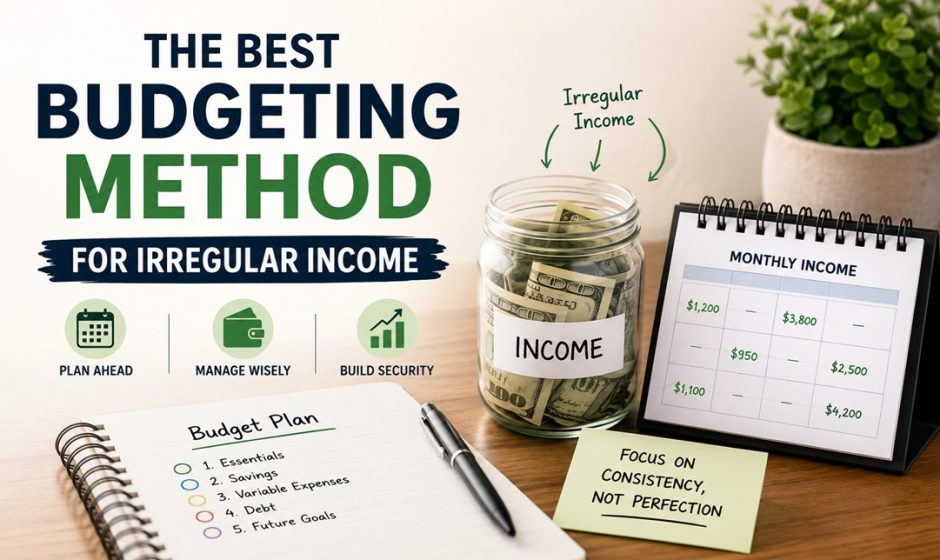

The best budgeting method for irregular income is the ‘pay yourself a salary’ approach — also called the baseline income method. Instead of budgeting based on what you earn each month, you calculate your average monthly income over six to twelve months, set a conservative baseline figure, and pay yourself that amount consistently. Surplus months go into a buffer account. Low months draw from it. This turns unpredictable earnings into a stable personal income.
Myth: Standard Budgets Cannot Work With Irregular Income
This is probably the most common belief among freelancers and contractors — and it is only half true. Traditional fixed budgets do not work well. But that does not mean all budgeting is off the table.
The problem with a standard monthly budget is the assumption that income stays roughly the same. When you earn $3,000 one month and $7,500 the next, a fixed budget built on either number creates constant stress. The solution is not to abandon budgeting — it is to change how income is tracked before you build the budget.
Reality: The Baseline Salary Method Works Well for Variable Earners
Here is how it works in practice. Over six months or longer, track your total earnings. Calculate the monthly average. Then reduce that figure slightly — many advisors suggest 10 to 20 percent lower — to create a conservative baseline.
That baseline becomes your personal monthly salary. You transfer that amount from your business or main account to your personal spending account at the start of each month, regardless of what you actually earned. Your budget is then built on that salary figure.
When a high-earning month comes in above your baseline, the extra stays in a dedicated buffer account. When a low month hits, you draw from the buffer instead of going into debt or cutting expenses suddenly.
Myth: You Need to Budget Every Category Tightly
Irregular earners often feel like tight category budgeting will bring control. In practice, it tends to cause frustration because the baseline income itself already varies. Over-categorising before stabilising income adds complexity without solving the root problem.
Reality: Focus on Fixed Costs First
A far more effective approach is to identify your fixed essential costs — rent or mortgage, utilities, insurance, loan repayments — and make sure your baseline salary comfortably covers those. Everything beyond that has more flexibility.
In Australia and the UK, where utility bills and rates can fluctuate seasonally, it helps to calculate average annual costs and divide by twelve rather than budgeting actual monthly bills. This smooths out the variation.
Other Methods That Can Help
The zero-based budget works reasonably well if you combine it with the salary baseline approach. Once you know your baseline monthly amount, assign every dollar of that amount to a purpose. The variable nature of actual earnings is handled by the buffer account rather than the budget itself.
The envelope method — or its digital equivalent using separate savings pockets — can help earners who struggle to avoid spending surplus months. Physically or digitally separating funds reduces the temptation to treat a high-income month as a spending windfall.
Practical Advice for Getting Started
Start by pulling together the last six months of income data. If you do not have records, bank statements work. Calculate the monthly average, then set your baseline 15 percent below that.
Open a dedicated buffer or holding account if you do not have one. Move your baseline salary to your personal account on the same day each month. Treat it like a paycheck from an employer.
Review the baseline every six months. If your income has consistently grown, adjust the figure upward. If you have had a run of lower months, you will know your buffer needs rebuilding before you raise spending.
This is not glamorous. It is boring and reliable — which is exactly what variable income needs.